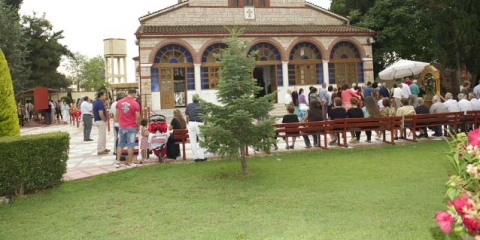
The Holy Monastery of Panagia Soumela or the Monastery of Soumela (Pontian: Sou Mela, from Mount of Mela) is a well-known Christian orthodox monastery near Trapezounda, a symbol of Pontian Hellenism for 16 centuries.
According to the tradition, in 386 the Athenian monks, Varnabas and Sophronios, were led to the pristine mountain peaks of Pontus, after the revelation of the Virgin Mary, in order to establish their monastic lodge. There, in a cave of the steep descent of the mountain, at an altitude of 1,063 meters, the sacred icon of the Virgin Mary the Athiniotissa, which, according to tradition, was illustrated by the Evangelist Luke, was transferred by angels.
The monks Varnabas and Sophronios, built with the support of the nearby monastery of Vazelona, a cell, and afterwards a church in the cave, in which the icon was miraculously transferred. The serious water supply problem of the monastery was also solved, according to tradition, in a miraculous way. Human logic fails to respond to the spectacle that even today's pilgrims see, to pour out sanctifying water through a granite rock. Its healing properties have made the monastery famous not only for Christians, but also for Muslims.
Near the cave was built, in 1860, a panoramic four-storey guest house of 72 rooms and other functional spaces for the needs of pilgrims as well as a library. Around the monastery were rebuilt small temples devoted to various saints.
The founders of the monastery continued their activity outside of the pilgrimage space. At a distance of 12 kilometers from the monastery, opposite the village of Skalita, they built the temple of Saints Constantine and Helen, and at a distance of two kilometers, the chapel of Saint Varvara, in which the monks in 1922 hid the icon of Megalohari (Virgin Mary), the cross of Emperor Manuel III the Komninos, and the manuscript of Saint Christopher's Gospel.
The monastery at times suffered from the raids of the heathens and the robbers, because of the reputation and the wealth it acquired. Some incidents are also associated with miraculous interventions of the Virgin Mary for the salvation of the monastery. In one of these raids, it was plundered by robbers and, always according to tradition, was destroyed, in order to be reconstructed by Saint Christopher from Trapezounda, in 644. The monastery was dowered with great fortune and many privileges, possessions, votive offerings and relics by the emperors of Byzantium and later, mainly by the Emperors of Trapezounda, Ioannis II Komninos (1285-1293), Alexios II Komninos (1293-1330), Vasilios I Komninos (1332-1340).
Great benefactors of the monastery were Manuel III Komninos (1390-1417), and Alexios III (1349-1390). The first one offered to the monastery a Cross of inestimable value with true cross, which today, after many adventures, is located along with the other relics of the monastery on its new throne, in Kastania of Veroia. Alexios III (1349-1390), whom Megalohari (Virgin Mary) saved from a great storm and helped him to defeat his enemies, gave the monastery, to show his gratitude, a great fortification, built towers, new cells and renovated its old buildings. He gave it 48 villages and instated 40 permanent guards for its security. Generally, he offered so much, so that he was declared by the monks the “new Founder”. Until 1650, the following Iambic inscription was preserved outside of the gate of the temple: Komninos Alexios in Christ powerful/ faithful King, Stable, Glorious, Great/ Forever Respected, Pious, Emperor/ All East and Iberia/ New Owner of this monastery was born (1360 AD) ????.
Many of the privileges granted by the Komninoi to the monastery were ratified and expanded during Ottoman domination with Sultanic decree and patriarchal sigilia (documents). The Sultans Vagiazit II, Selim I, Murat III, Selim II, Ibrahim I, Muhammad IV, Suleiman II, Mustafa II, Ahmet III, are listed in the monastery codes as benefactors.
The favor which the emperors showed to a great extent to the monastery is not only the result of religiousness, but also of the personal perception of the divine intervention. It is characteristic, as it has already been mentioned, the miraculous rescue of Alexios III by a terrible wreck. However, the Sultans who benefited the monastery had personal experiences of the miracles performed by Panagia (Virgin Mary) of Soumela.
Referring to the case of Sultan Selim I, who was healed of a serious illness by means of the monastery's sanctification.
Valuable documents and many ancient manuscripts were kept in the monastery's library until the uprooting. Inside the library of the monastery, in 1868, the researcher Savvas Ioannidis found the first Greek manuscript of Digenis Akritas.
The monasteries of Pontus suffered from the brutal and dishonest behavior of the Turks and the Kemalikoi, who fanaticized the wild and predatory Muslim groups. Many times they have been the victims of robberies and disasters. In 1922 the Turks completely destroyed the monastery.
After they had robbed all the precious objects that were in the monastery, they set fire to obscure the traces of their crimes or to satisfy their hatred against the Greeks. The monks before the forced exodus in 1923, hid in the chapel of Saint Barbara, the icon of the Virgin Mary, the gospel of Saint Christopher and the cross of the emperor of Trapezounda, Manuel Komninos.
In June 2010, the Turkish State granted permission to the Ecumenical Patriarchate to celebrate the service of the Assumption of the Virgin, on the 15th of August 2010, in the historic monastery, with Turkey expecting both the respect to the religious freedoms and the economic benefits of increasing the number of tourists in the area these days. In the decision to open the monastery for one day, the Russian Church also claims to share. This was the first time after 88 years that the monastery once again operated as a church, as the last years it had been transformed into a museum.
The modern monastery in Veroia
With the actions of the Prime Minister of Greece Eleftherios Venizelos, in 1930, when Turkish Prime Minister Ismet Inonou, visited Athens, in the context of the then Greek-Turkish friendship, he accepted a delegation to go to Pontus and receive the symbols of Orthodoxy and Hellenism.
In 1930, only two monks of the ancient historic monastery were alive; The decrepit Jeremiah in Lagadas, Thessaloniki, who refused to go because he wasn’t able to walk or because he did not want to relive the nightmarish scenes of Turkish barbarity, and the gorgeous, lively and alive Amvrosios Soumeliotis, head of the church of Saint Therapon of Toumba in Thessaloniki. From the monk Jeremiah, Amvrosios learnt the crypt of the inestimable heirlooms. On 14 October, Amvrosios left with a flattering document of the Turkish embassy for Constantinople and from there to Trapezounda, with destination Panagia (Virgin Mary) of Soumela. A few days later he returned to Athens not only with our symbols, but also with Pontus, as the Minister of Providence of the government of Eleftherios Venizelos, Leonidas Iasonidis wrote: "There were the Pontius in Greece but there was no Pontus. With the icon of Panagia of Soumela, Pontus also came. "
The icon was hosted for 20 years in the Byzantine Museum of Athens. Leonidas Iassonidis first proposed in 1931 the re-establishment of Panagia Soumela in an area of Greece. In particular, he wrote in the “Patris” newspaper of Athens: "We searched in our New Lands, an old Stavropegic monastery, rocky and ???, similar to the Pontus deserted one, we will rename it to" New Panagia of Soumela "and give it to spiritual relief and consolation three hundred and fifty thousand of the Pontius, for the sake of Athos! And so will to this generous nation be given the opportunity to organize the festivals and to continue the ceremonies and to show the truths of those cosmopolitan times during the anniversaries of the Virgin celebration, taking the icon of the 17 Pontian ages, feeling the old vibes of emotion, reviving the faith in the homeland and sing with the company of the Pontian lyre an unforgettable song.
Indeed, in 1951, the visionary and builder, Philon Ktenidis from Kromnaia, made the wish of all Pontians come true, with the founding of the New Panagia Soumela on the slopes of Vermio in Kastania of Veroia.
Every year on August 15, the feast of Panagia (Virgin Mary), thousands of visitors (Pontius and non) from all over Greece, flock to Panagia of Soumela to worship and watch the events taking place in the area (e.g. Pontian dance groups etc.)