The erection of the current church began around 1850 on the place of an older temple serving the needs of the patients and staff of the hospital, the well-known “hotel” of Mytilene, which operated right across, at the place of the current Ecclesiastical Byzantine Museum.
We do not know when exactly the “hotel” and the temple were built. The earliest historical evidence of the operation of the hospital dates back to 1692. Most scholars believe that the temple would have been there from at least that time. This temple, which was characterized by the sources of that time as a miserable building, was probably built at the place where a significant ancient building was located. Some views present it as a temple of Apollo, the dominant god of Mytilene and others as a building where the school of the lyric poet Sapfo was housed. The existence of an ancient building is also testified by the number of architectural parts that had been walled in this older temple.
The Metropolitan of Mytilene Kallinikos, later Patriarch of Alexandria, envisioned the erection of the new temple. Fundraisers were carried out for the construction of the temple on Kalliniko’s initiative.
The dimensions of the temple required work from an architect with experience in the construction of large buildings. At that time, architect Argyris Adalis from Mytilene, who served as an assistant to the two greatest architects of the time, Danish Theophilos Hansen and German Ernest Ziller, was at the zenith of his career. The experience he had gained with them during the erection of the Akadimia and Zappio buildings in Athens allowed him to devise with complete success the design of the church of Saint Therapon and the neighboring Secondary School of Mytilene.
It is certain that the new temple, although unfinished, began operating in 1900.
The temple's basic architectural style is the Byzantine architectural style. Inside, the temple stands out for the Gothic morphological features, the presence of which is due to the influence that Adalis received from his masters.
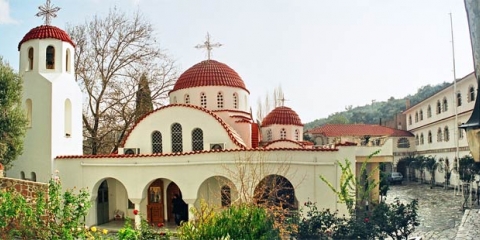
The exterior decoration is the creation of the famous painter and sculptor of Mytilene Nikolaos Kesanlis. The variety of the elements it consists of, makes it stunning. The temple is built with carved stones. It is well known that much of the material for its erection was transferred from the famous quarry “Sarmosak” of Asia Minor. On the front there are two consecutive series of columns, of Ionic and Corinthian rhythm. Five domes are placed on the top of the building. The central dome with a zinc coating gives a sense of eminent grandeur.
Each dome is based on pediments, some of which have been decorated with paintings (unfortunately barely distinguished due to the wear and tear of time) and very remarkable sculptures.
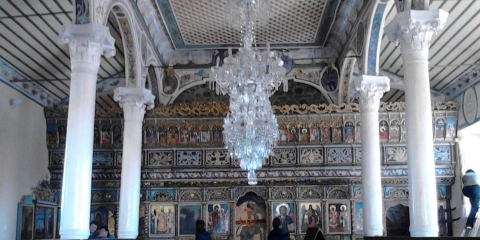
The wood-carved iconostasis of the temple is a work of 1915 and has been created by the hand of a crafty sculptor of Mytilene, Dimitrios Kovalas, as it is testified by its inscription. The same artist crafted the pontifical throne, the pulpit and the two great “proskinitaria” (furniture on which is placed the Holy Bible so the people can pilgrim) of the temple.
The temple hosts the tomb of the Metropolitan Ignatius of Ounggrovlahia who was descended from Mytilene, one of the great protagonists of the Revolution of 1821. His marble sarcophagus is placed in the main temple. The most important heirloom of the church is the icon of Saint Therapon dated to the year 1651.